Introduction:
Look, if you walk into the Gold & Silver Pawn Shop in Las Vegas expecting a dusty corner store, you’ve already missed the point. Most people see the television cameras and the witty banter, but beneath that layer of entertainment lies a complex, high-velocity machine of asset liquidation and capital arbitrage. To understand The 5 Richest Pawn Stars, you have to look past the items being haggled over and focus on the mechanics of the “spread.” We are talking about the gap between immediate cash liquidity and the long-term appreciation of rare assets. It’s a business model that relies on the desperation or the impatience of others to fuel a massive, self-sustaining wealth engine.
The math of a pawn shop is actually quite beautiful if you’re the one holding the license. In Nevada, interest rates on pawned items are regulated but highly lucrative, effectively acting as a high-yield lending facility for the general public. When you combine that steady interest income with the ability to buy high-value goods at 30% to 50% of their actual market value, you create a cash-flow monster. The 5 Richest Pawn Stars didn’t just get lucky with a reality show; they leveraged a localized monopoly on short-term lending and turned it into a global brand that reduced their customer acquisition costs to virtually zero.
Every person on this list understands one thing: cash is a tool, but equity is the fortress. They haven’t just sat on their television salaries. Instead, they’ve funneled that liquidity into blue-chip stocks, commercial real estate, and proprietary business verticals that function as “legacy annuities.” This deep dive into The 5 Richest Pawn Stars isn’t about their life stories; it’s a breakdown of the business mechanics—the equity stakes, the inventory velocity, and the land holdings—that have made them some of the most liquid entrepreneurs in the American West.
1. Danny Koker – Estimated Net Worth: $13 Million+
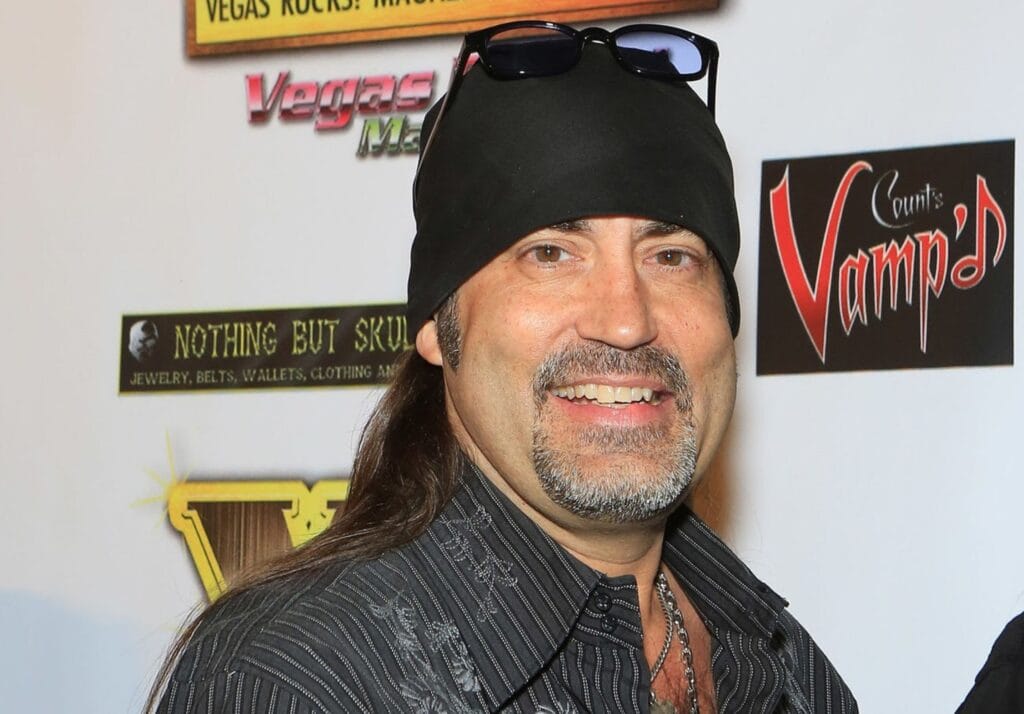
Danny “The Count” Koker might have started as a frequent expert guest, but he quickly became the primary financial heavyweight in the ecosystem. His wealth mechanic is built on “Restoration Arbitrage.” While a pawn shop focuses on buying low and selling high, Koker’s business, Count’s Kustoms, focuses on taking a distressed asset—usually a rusted-out classic car or a forgotten motorcycle—and applying specialized labor to exponentially increase its market value. By owning the restoration facility, he doesn’t just profit from the sale; he captures the profit margin on every hour of labor and every part installed. This vertical integration makes him a standout among The 5 Richest Pawn Stars.
Koker’s “Asset-First” strategy is visible in his personal garage, which functions more like a diversified investment fund than a car collection. He holds over 50 high-value vehicles, ranging from one-of-a-kind hot rods to rare European exotics. Unlike traditional stocks, these physical assets are inflation-hedged and have a historical track record of appreciation. He treats his inventory like a hedge fund manager treats a portfolio—constantly “rebalancing” by selling at the peak of a trend and buying undervalued frames that his team can transform. This is the “hard asset” foundation that protects his $13 million fortune from the volatility of the entertainment industry.
Beyond the garage, Koker has mastered the art of “Cash-Flow Cross-Collateralization.” He owns Count’s Vamp’d Rock Bar & Grill and Count’s Tattoo Company. These are high-volume, liquid-cash businesses that provide a daily revenue stream regardless of whether a car sells that week. This diversification is a key pillar for the elite members of The 5 Richest Pawn Stars. By owning businesses that cater to the same demographic—enthusiasts of rock culture, cars, and tattoos—he creates a closed-loop economy where a customer might buy a drink, get a tattoo, and eventually commission a bike build.
The final piece of his financial puzzle is “Syndication Equity.” As the star and producer of his own spin-off, he holds a significant stake in the show’s intellectual property. This functions as a “legacy annuity,” providing him with residual checks from global broadcasting rights that continue to flow even when the cameras aren’t rolling. Koker has effectively decoupled his income from his physical presence, allowing his brand and his assets to do the heavy lifting. This level of institutional-grade wealth management is exactly why he leads the pack of the wealthiest figures in the pawn universe.
2. Rick Harrison – Estimated Net Worth: $9 Million+
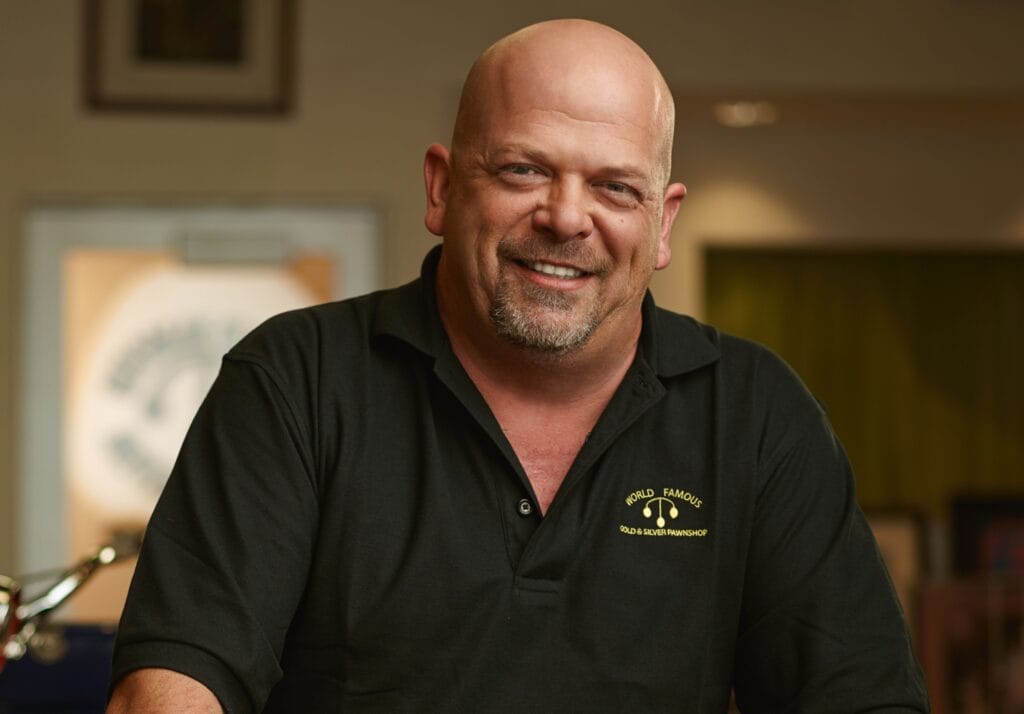
Rick Harrison is the quintessential strategist of the group, and his wealth is a byproduct of a very disciplined capital allocation model. He famously follows an “80/10/10” rule: 80% of his liquid wealth is invested in blue-chip, dividend-paying stocks; 10% is held in gold and silver as a hedge against currency devaluation; and the final 10% is his “play money” for speculative pawn buys. This conservative approach to wealth preservation ensures that he remains one of The 5 Richest Pawn Stars even if the pawn shop has a slow month. He isn’t just a shopkeeper; he is a professional investor who happens to own a pawn shop.
The core of his business wealth is the “Pawn Interest Annuity.” Before the show existed, the shop was already a multi-million dollar lending facility. In the pawn business, the “yield” comes from the interest charged on loans. If a customer doesn’t pay, Rick keeps the collateral, which he then sells for a massive profit. This creates a “heads-I-win, tails-you-lose” financial scenario that is the bedrock of the pawn industry. Harrison has used this steady cash flow to acquire significant commercial real estate holdings in Las Vegas, including the land the shop sits on and the surrounding retail developments.
Harrison has also utilized “Foot-Traffic Arbitrage” to expand his empire. Recognizing that millions of tourists visit the shop annually, he developed “Pawn Plaza,” a retail and dining complex made of shipping containers right next door. By becoming the landlord for other businesses—and owning his own restaurant, Rick’s Rollin’ Smoke BBQ—he captures the discretionary spending of people who are simply standing in line to see the shop. This move into “Retail Real Estate” is a classic mechanic used by The 5 Richest Pawn Stars to turn a singular point of fame into a diversified revenue stream.
Finally, his wealth is protected by “Intellectual Property Licensing.” Rick has authored best-selling books and holds various trademarks that generate passive income through royalties. He treats his likeness as a corporate asset, licensing it for everything from mobile games to international endorsements. This “brand equity” is far more valuable than any single item in his shop, as it provides a high-margin income stream with zero inventory risk. He has successfully transformed himself into a living, breathing blue-chip asset, securing his status as a permanent fixture in the financial elite of Nevada.
3. Richard “Old Man” Harrison – Estimated Net Worth (Estate): $8 Million+
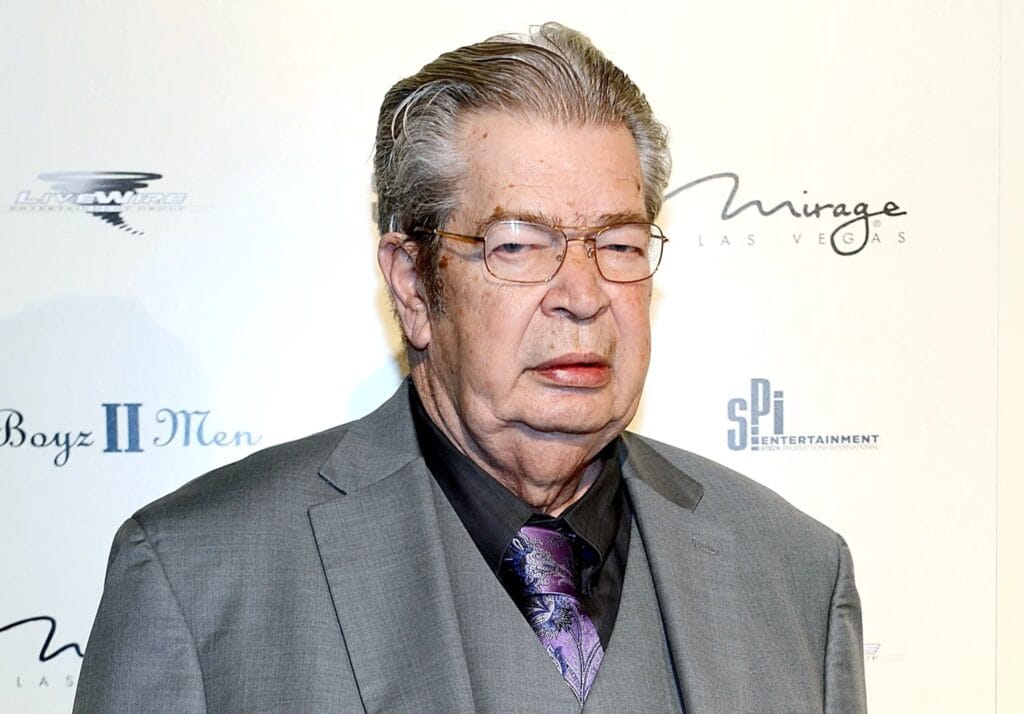
The late “Old Man” was the architect of the family’s foundational wealth, and his approach was rooted in “Anti-Debt Philosophy.” He believed in owning everything outright—the land, the building, and the inventory. By avoiding the trap of high-interest commercial loans, he ensured that the shop had incredibly low overhead, allowing it to survive economic downturns that wiped out his competitors. In the world of The 5 Richest Pawn Stars, the Old Man represents the “Fixed Asset” layer of the portfolio, where the goal isn’t just growth, but total capital security.
His wealth mechanic was the “Pawn License Monopoly.” In a city like Las Vegas, obtaining and maintaining a 24-hour pawn license is an arduous process with high regulatory barriers. He viewed this license as a “barrier to entry” asset that effectively functioned as a localized monopoly. This license allowed the family to act as a quasi-bank for decades, accumulating a massive “inventory float” of jewelry, bullion, and rare coins. This float is a form of hidden equity; while it appears as “stuff” on a shelf, it is actually a highly liquid reserve of precious metals and stones that appreciate over time.
The Old Man was also a master of the “Classic Car Hedge.” He treated his personal collection—including his prized 1966 Chrysler Imperial—as “Rolling Capital.” These were not mere toys; they were meticulously maintained assets that could be liquidated in 48 hours if the business ever needed a cash infusion. This “Tier 2 Liquidity” is a common theme among The 5 Richest Pawn Stars. They don’t keep their money in a savings account; they keep it in items that have intrinsic value and a global market, ensuring that their net worth is never tied to the fate of a single currency.
Even after his passing, his estate continues to function as a “Legacy Annuity” for the Harrison family. The trust he established holds significant commercial property and ongoing royalties from the show’s syndication. Because he focused on “Hard Assets” rather than speculative digital ventures, his wealth remains a stable, generating force. He proved that the most boring way to build wealth—buying land and holding onto high-value physical goods—is often the most durable strategy for remaining one of the elite figures in the pawn industry.
4. Austin “Chumlee” Russell – Estimated Net Worth: $5 Million+
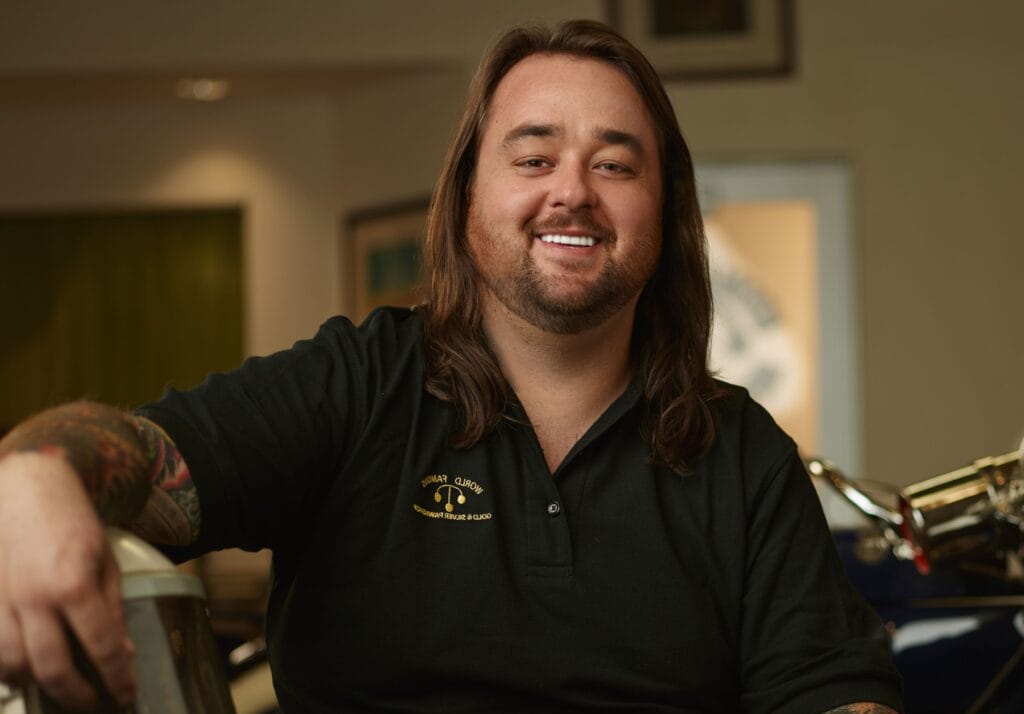
Austin Russell, known globally as Chumlee, is the “Retail Branding” genius of the group. While critics might have underestimated him early on, his wealth mechanic is a brilliant example of “Niche Market Capitalization.” He recognized early that his “relatable” persona was a massive marketing asset. He was the first in the group to aggressively pursue private branding deals and personal merchandise. By owning the rights to his own image and likeness, he created a secondary income stream that is entirely independent of his work at the pawn shop. Among The 5 Richest Pawn Stars, he is the king of the “Side-Hustle Equity.”
His most significant business move was the launch of “Chumlee’s Candy on the Blvd.” This wasn’t just a passion project; it was a “Foot-Traffic Conversion” play. Located directly across from the pawn shop, the candy store capitalizes on the thousands of families that visit the area. The margins on candy and soda are significantly higher than the margins on high-end pawn items, which require massive capital outlays. This “High-Margin, Low-Entry” business model provides Chumlee with a liquid-cash business that complements his more static investments.
Chumlee also engages in “Liquid Collectible Arbitrage.” He is an expert in the high-end sneaker and streetwear market, often buying rare releases and holding them for short-term appreciation. This “Alternative Asset Class” is a modern wealth mechanic that many older investors ignore, but for the younger demographic of The 5 Richest Pawn Stars, it is a legitimate way to diversify. His collection of rare Nikes and luxury watches represents hundreds of thousands of dollars in “wearable equity” that can be liquidated instantly in the global secondary market.
Additionally, he has built a “Digital Revenue Stream” through personal appearances and social media. In the current economy, attention is a currency, and Chumlee has millions of followers that he can leverage for five-figure appearance fees and sponsored content deals. This “Portable Income” is crucial because it doesn’t require a physical shop or inventory. He has successfully turned his personality into a “Digital Annuity” that will continue to pay out as long as he maintains his public profile, making him one of the most financially agile members of the cast.
5. Corey “Big Hoss” Harrison – Estimated Net Worth: $4 Million+

Corey Harrison is the “Succession Strategist” of the family, and his place among The 5 Richest Pawn Stars was cemented through a high-stakes “Equity Negotiation.” Early in the show’s success, Corey demanded a 5% ownership stake in the Gold & Silver Pawn Shop, threatening to leave if his demands weren’t met. This was a masterclass in “Leveraging Personal Value for Permanent Equity.” By becoming a partner, he moved from being a salaried employee to an owner who receives a share of the “net profit” of the entire operation. This equity stake is his most valuable asset, providing a yearly dividend that far exceeds any TV salary.
His wealth mechanic also includes “Secondary Pawn Ventures.” Corey has been involved in several other pawn and lending businesses outside of the main shop, allowing him to diversify his “lending risk.” He understands that the pawn industry is a “Volume Game,” and by having interests in multiple locations, he can capture a larger share of the Las Vegas loan market. This “Horizontal Expansion” is a key strategy for the younger generation of The 5 Richest Pawn Stars who are looking to build their own independent empires outside of their family’s shadow.
Corey is also a major player in “Residential Real Estate Flipping.” He has bought and sold several high-end properties in the Las Vegas area, often making a significant profit on each transaction. He treats his homes like inventory—buying distressed luxury properties, renovating them, and selling them when the market peaks. This “Real Estate Arbitrage” allows him to generate large chunks of capital that he can then reinvest into more stable, dividend-paying assets. He views his lifestyle as a series of “Asset Cycles” rather than permanent fixtures.
Finally, his “Legacy Position” ensures that his future net worth is tied to the total valuation of the Harrison family holdings. As he takes on more management responsibility, he is effectively being groomed to oversee a multi-million dollar “Institutional Trust.” In the world of The 5 Richest Pawn Stars, Corey represents the “Growth Stock”—an individual whose current net worth is impressive, but whose future equity in the family’s land, licensing, and brand name is astronomical. He has successfully positioned himself as the heir to a financial fortress built on silver, gold, and television ratings.
Conclusion on The 5 Richest Pawn Stars
The financial reality of these five men proves that the pawn industry is one of the most resilient and profitable sectors of the American economy. The 5 Richest Pawn Stars have shown that “The Hustle” is just the beginning; the real wealth comes from turning that hustle into “Hard Assets” and “Permanent Equity.” Whether it is Rick’s blue-chip stocks, Danny’s restoration facility, or the Old Man’s land holdings, each of these individuals has focused on building a “Capital Base” that produces income independently of their own labor. They have moved from being “characters” on a show to being “sovereigns” of their own financial destinies.
Ultimately, the story of The 5 Richest Pawn Stars is a case study in “Modern Wealth Preservation.” They have decoupled their net worth from the traditional entertainment industry by reinvesting their earnings into real estate, liquid collectibles, and proprietary business brands. They have created a series of “interlocking annuities” that ensure their wealth will continue to grow for generations. As long as there is someone in Las Vegas looking for a quick loan or a unique collectible, the financial machines built by these Richest men will continue to hum, turning the world’s “dead capital” into their own active, compounding fortunes.