When we pivot our gaze toward the Top 5 Most Expensive Perfumes, we are no longer discussing simple olfactory aesthetics. In the arena of the global elite, a fragrance is rarely just about the scent; it is a “legacy annuity” and a portable asset class. Much like a rare vintage of Romanée-Conti or a pre-war Bugatti, these scents represent a concentration of capital that defies traditional consumer logic. We are looking at the business mechanics of scarcity, the vertical integration of diamond sourcing, and the brand-equity moats that protect seven-figure valuations.
To understand the Top 5 Most Expensive Perfumes, one must adopt an asset-first focus. Why would an individual park $1.5 million in a single bottle of liquid? It isn’t for the jasmine or the sandalwood. It is for the equity stake in a brand’s most exclusive tier. These bottles function as wealth silos—physical objects that store value through a combination of rare-earth metals, high-carat gems, and the “sweat equity” of thousands of hours of artisan labor. They are hedges against the volatility of traditional markets, providing a tangible, liquid (literally and figuratively) form of net worth.
In this analysis, we strip away the marketing fluff to examine the gears that drive the pricing of the Top 5 Most Expensive Perfumes. We will look at how brand history, material provenance, and sheer mechanical audacity converge to create assets that appreciate over time. These are the scents that define the ceiling of the luxury economy, where the liquid inside is merely the heartbeat of a much larger, more complex financial animal.
1. Morreale Paris Le Monde Sur Mesure ($1.8 Million)
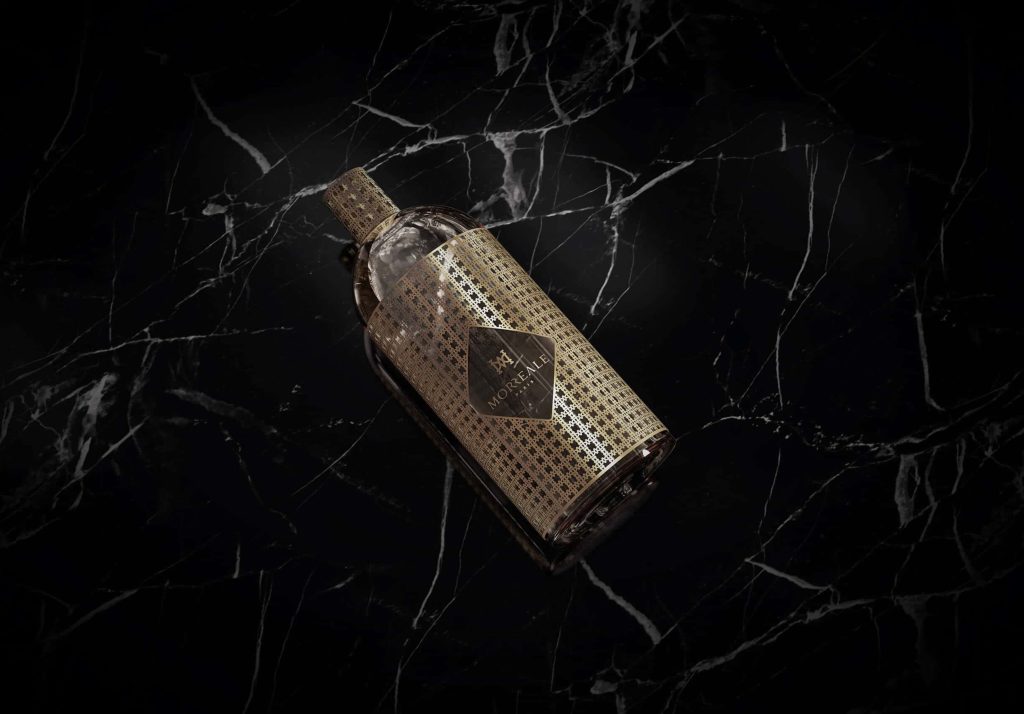
At the pinnacle of the Top 5 Most Expensive Perfumes sits the Morreale Paris Le Monde Sur Mesure. This isn’t just a fragrance; it is a bespoke wealth management vehicle. Valued at $1.8 million for its most exclusive iteration, the business mechanic here is “Absolute Customization.” An anonymous buyer doesn’t just buy a scent; they participate in a year-long R&D process involving a team of 35 people to create a “liquid signature” that is entirely unique to their family or personal brand. This creates an “Equity Moat” where the scent itself cannot be duplicated, legally or chemically, by any other entity.
The asset-first value is anchored in the bottle’s physical construction. Encrusted with over 1,000 diamonds and finished in two kilograms of pure gold, the flacon acts as a physical store of value. However, the true “Legacy Annuity” lies in the recurring service: once the initial $1.8 million asset is acquired, the owner has the exclusive right to refill the bottle with their unique scent, ensuring a lifelong connection to the Morreale heritage. This model mirrors the mechanics of a high-end real estate development—the initial purchase is the entry, and the ongoing exclusivity is the dividend.
From a structural standpoint, the Morreale Paris model leverages the “halo effect” of extreme pricing to elevate the entire brand. By holding the record for the world’s most expensive perfume, Morreale Paris creates an aura of invincibility. For the collector, this is an “Asset-First” play because the historical significance of owning the world’s most expensive scent provides a level of social capital that is often more valuable than the gold and diamonds themselves. It is a statement of being at the very top of the food chain, where price is no longer a constraint but a filter for exclusivity.
The Top 5 Most Expensive Perfumes list wouldn’t be complete without this masterpiece, which redefined what a perfume could be in the 21st century. It shifted the conversation from “scent” to “legacy.” The manufacturing process is so labor-intensive that only a handful of these can ever exist, protecting the resale value for future generations. It is a “Long-Term Hold” in the most literal sense, a piece of art that happens to smell like the rarest ingredients on Earth.
2. Shumukh by Nabeel ($1.29 Million)
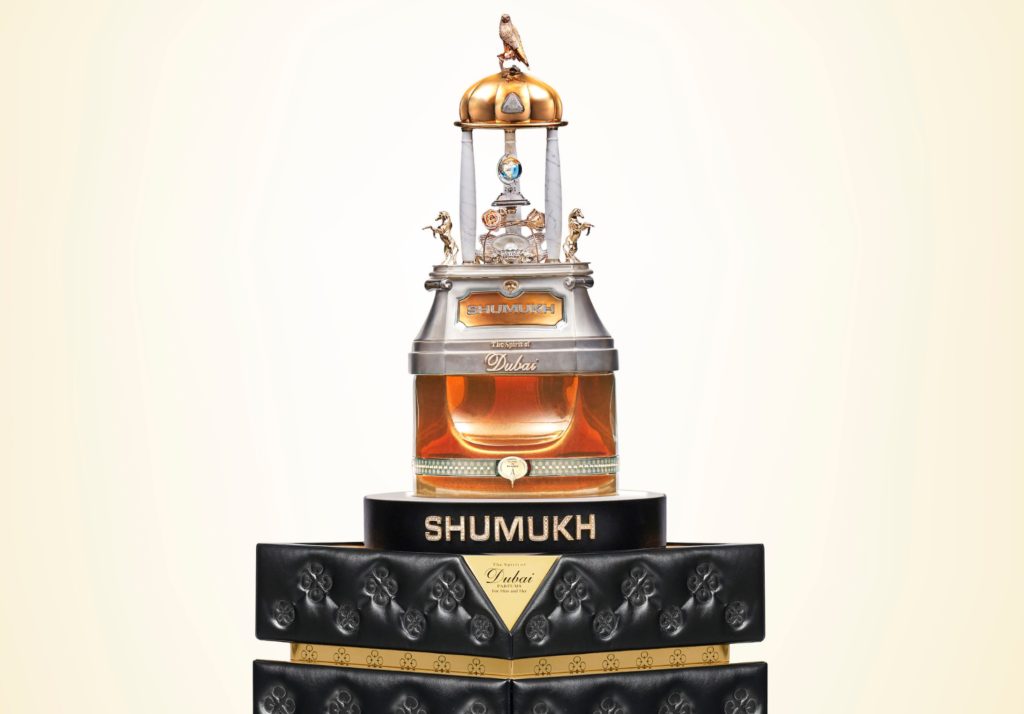
Coming in as a titan of the Middle Eastern market, Shumukh—which translates to “deserving the highest”—is a $1.29 million marvel from The Spirit of Dubai. The business mechanic here is “Symbolic Aggregation.” The bottle stands nearly two meters tall and holds two Guinness World Records: one for the most diamonds set on a perfume bottle (3,571) and another for being the tallest commercially available remote-controlled fragrance spray bottle. This isn’t just a product; it is a “Trophy Asset” designed to showcase the industrial and artistic might of the UAE.
Analyzing the asset-first focus, Shumukh is a masterclass in material dominance. It features 38.55 carats of diamonds, giant pearls, 2.5 kg of 18-karat gold, and 5.9 kg of pure silver. The “Structural Integrity” of this investment is found in the raw market value of these materials, which provides a price floor for the asset. Even if the fragrance market were to shift, the intrinsic value of the gold and diamonds remains. This makes Shumukh a “Hard Asset” that functions similarly to a high-end jewelry collection, but with the added “brand equity” of the Spirit of Dubai name.
The scent itself took three years and 494 trials to perfect, utilizing rare notes like Indian agarwood, sandalwood, Turkish rose, and patchouli. In the mechanics of luxury, this R&D time is a non-recurring engineering cost that justifies the premium. For the owner, Shumukh is a “Legacy Annuity” that pays off in the form of historical preservation. It is a piece that tells the story of Dubai—from falconry to pearl diving—immortalized in precious metals. It remains a cornerstone of the Top 5 Most Expensive Perfumes due to its sheer scale and the audacity of its engineering.
Furthermore, the remote-controlled aspect introduces a “Mechanical Complexity” moat. Most perfumes are passive objects; Shumukh is an active, kinetic sculpture. This crossover into the world of high-end robotics and automation adds another layer of exclusivity. It appeals to the technocratic elite who value not just beauty, but the technical mastery required to make that beauty functional at a monumental scale. It is a definitive entry in any discussion of the Top 5 Most Expensive Perfumes.
3. DKNY Golden Delicious Million Dollar Fragrance Bottle ($1 Million)
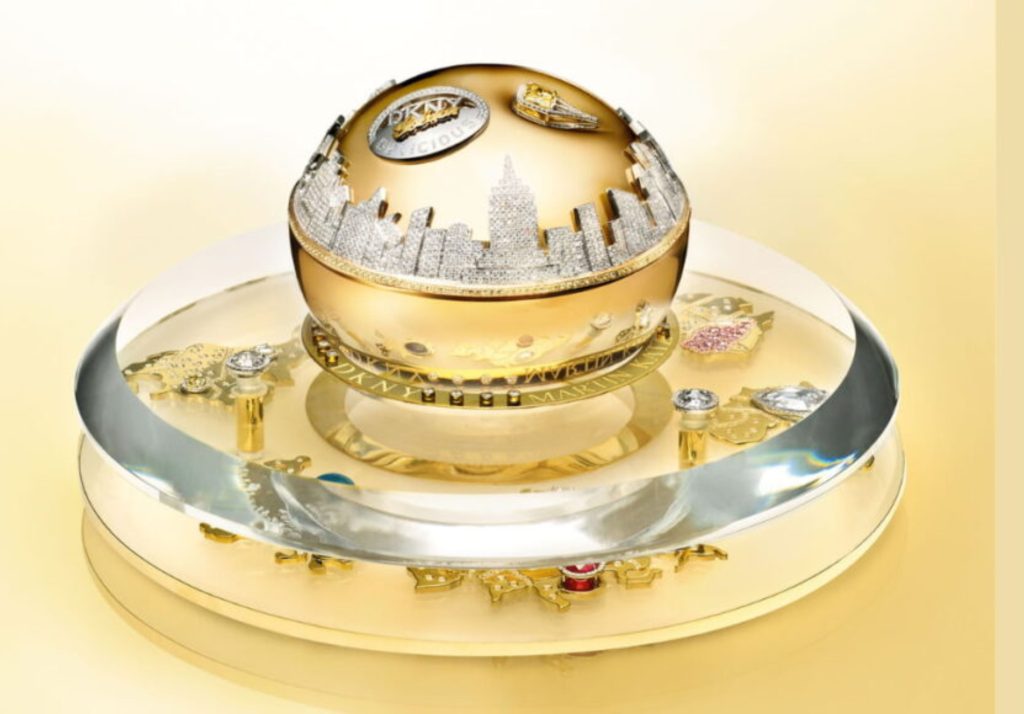
The DKNY Golden Delicious “Million Dollar” bottle is perhaps the most famous entry in the Top 5 Most Expensive Perfumes. Launched as a collaboration between DKNY and celebrity jeweler Martin Katz, the business mechanic here was “Philanthropic Brand Elevators.” The piece was created as a unique art piece, with proceeds from its sale going to the charity Action Against Hunger. This move created a massive “Social Equity” moat for the brand, positioning a mass-market fragrance (Golden Delicious) alongside the most expensive assets in the world.
The asset-first focus of this piece is found in its intricate “Skyline Mechanics.” The bottle is carved from 14-karat yellow and white gold and features 2,909 precious stones. These include 183 yellow sapphires, 2,700 white diamonds, a 7.18-carat oval sapphire from Sri Lanka, and 15 pink diamonds from Australia. The stones were hand-placed over 1,500 hours to resemble the New York City skyline. This level of artisanal labor creates a “Sweat Equity” value that far exceeds the sum of its parts. It is a portable piece of Manhattan real estate, captured in gems and gold.
Structurally, the DKNY project was a masterstroke of marketing mechanics. By taking a $50 fragrance and housing it in a $1 million bottle, the brand effectively “hacked” the luxury hierarchy. For the high-net-worth individual who eventually acquired it, the value wasn’t just in the stones; it was in the “Provenance Moat.” Being the owner of a “Piece Unique” that was globally toured and celebrated adds a layer of intangible value that traditional retail cannot offer. This is why it remains a permanent fixture in the Top 5 Most Expensive Perfumes.
The “Evergreen Style” of this piece is found in its timeless tribute to New York. Unlike fashion-forward designs that might age poorly, the NYC skyline is a permanent icon of global commerce and ambition. This ensures that the bottle will remain a sought-after artifact for decades. It is a “Legacy Annuity” for the brand, which continues to benefit from the prestige of having created the world’s first $1 million perfume bottle.
4. Bvlgari Opera Prima ($235,000)
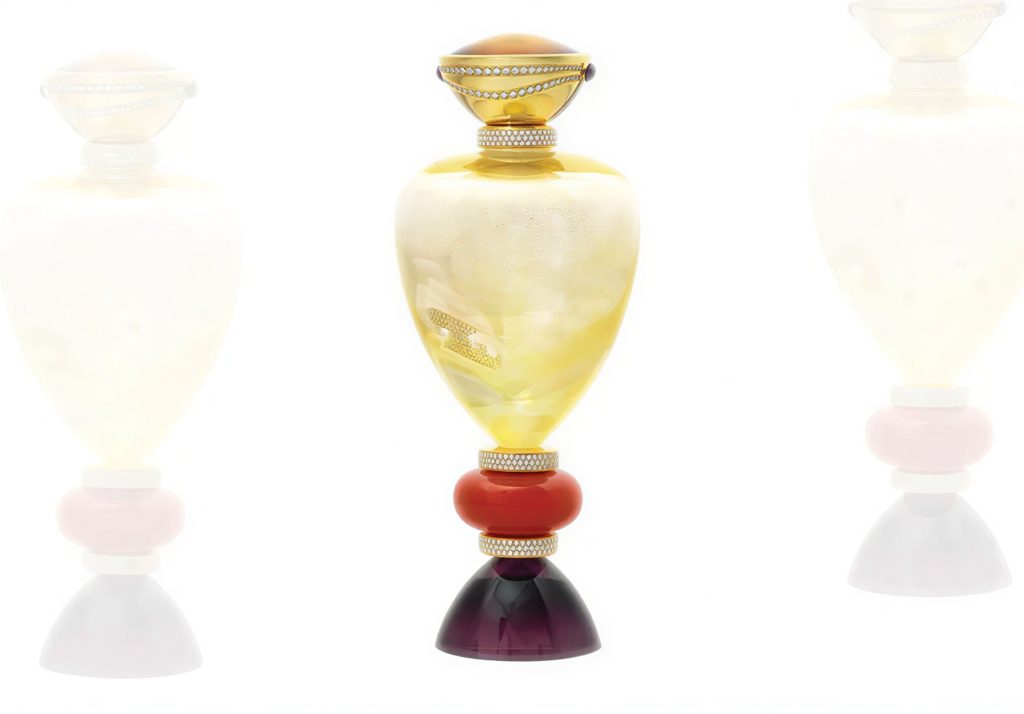
Bvlgari’s Opera Prima, valued at approximately $235,000, represents the business mechanic of “Inter-Brand Synergy.” Created to celebrate the house’s 130th anniversary, it brings together the mastery of Italian glassmaking (via Venini) and Bvlgari’s own heritage in high jewelry. The asset-first focus here is on the “Total Craftsmanship Moat.” This isn’t just a bottle; it’s a flacon embellished with 250 carats of citrine, 4.45 carats of amethyst, and 25 carats of diamonds. It represents an “Equity Stake” in the peak of Italian artisanal culture.
The mechanics of this piece are rooted in the concept of “Historical Appreciation.” As Bvlgari continues to grow as a global luxury powerhouse, its anniversary pieces—especially those that involve rare glasswork—become increasingly valuable to collectors. The use of citrine and amethyst, while less expensive than high-grade diamonds, provides a unique “Color Equity” that is a signature of the Bvlgari brand. This makes the piece instantly recognizable and helps maintain its “Structural Integrity” in the secondary market.
In the world of the Top 5 Most Expensive Perfumes, the Opera Prima stands out for its Mediterranean “Essence Equity.” The scent, created by Daniela Andrier, uses lemon and orange blossom to evoke the spirit of Italy. This creates a powerful brand story that justifies the price to those who view luxury as an extension of cultural heritage. For the owner, this is a “Legacy Annuity” that celebrates a specific moment in time—the 130th year of a legend—making it a finite asset that can never be “re-anniversaried.”
Furthermore, the collaboration with Venini glass adds a layer of “Vertical Integration.” By partnering with the absolute best in a complementary field, Bvlgari ensures that every aspect of the product is “Best in Class.” This eliminates any weak points in the asset’s value chain. It is a cohesive, multi-disciplinary investment that earns its place among the Top 5 Most Expensive Perfumes by proving that luxury is the sum of all its perfected parts.
5. Clive Christian No. 1 Passant Guardant ($228,000)
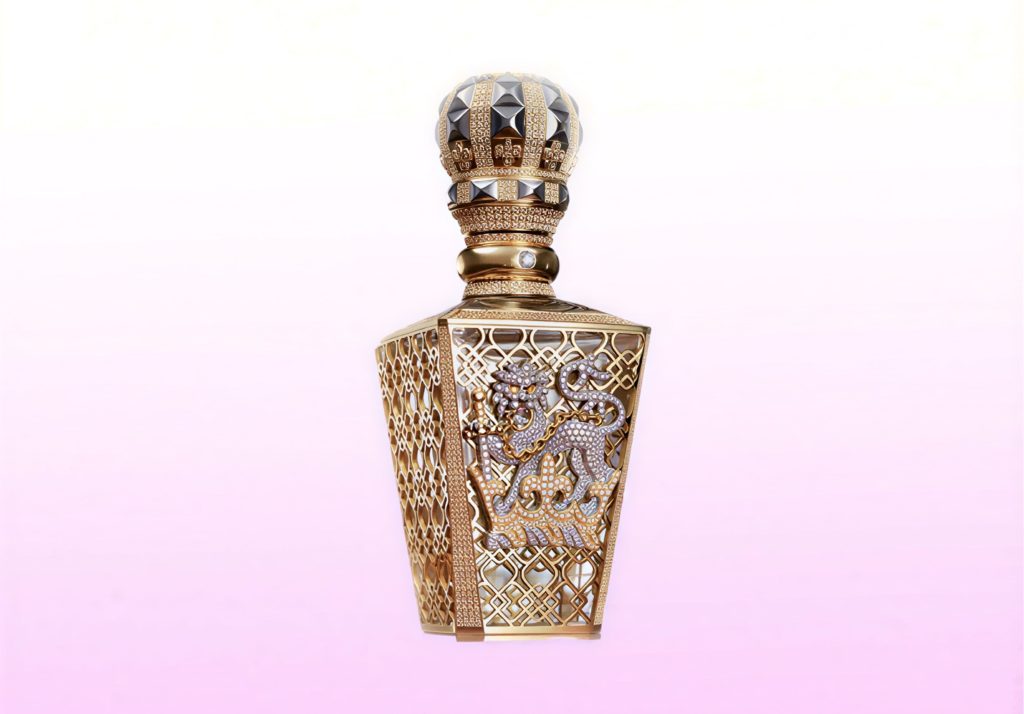
The final entry in our breakdown of the Top 5 Most Expensive Perfumes is the Clive Christian No. 1 Passant Guardant. Priced at $228,000, the business mechanic here is the “Royal Warrant Moat.” Clive Christian is the only brand permitted to use the image of Queen Victoria’s crown on its bottles, an honor granted in 1872. This historical connection creates a form of “Sovereign Equity” that other brands simply cannot buy. The Passant Guardant is the ultimate expression of this regal heritage, housed in a crystal flacon covered in 24-karat gold latticework.
From an asset-first perspective, the Passant Guardant functions as a “Concentrated Status Symbol.” It features over 2,000 hand-set white diamonds and a lion motif with yellow and pink diamond eyes. The “Mechanical Integrity” of the piece lies in the hand-latticework, a technique that requires extreme precision to ensure the gold adheres to the crystal without obscuring the light. This is an “Artisanal Barrier” that prevents mass production and protects the asset’s scarcity.
The scent itself is an evergreen blend of bergamot, Sicilian mandarin, and rare spices. For the collector, the value is in the “Permanent Prestige.” Clive Christian has spent decades positioning “No. 1” as “The World’s Most Expensive Perfume” (a title it held for years before the seven-figure entries appeared). This “First-Mover Advantage” in the ultra-luxury perfume space means that its top-tier editions always carry a “Legacy Annuity” of brand recognition. It is a “Blue Chip” fragrance asset.
As part of the Top 5 Most Expensive Perfumes, the Passant Guardant serves as a reminder that history is the most expensive ingredient of all. You can buy diamonds and gold anywhere, but you cannot buy 150 years of royal approval. This intangible equity is what keeps the price anchored in the stratosphere. It is a “Security Asset” for the brand, ensuring they remain the standard-bearer for traditional British luxury in an increasingly crowded global market.
Conclusion: The Olfactory Portfolio
The Top 5 Most Expensive Perfumes demonstrate that the fragrance industry is no longer just about selling “hope in a bottle”; it is about selling “equity in a bottle.” By focusing on the asset-first mechanics—rare materials, artisanal barriers, and historical provenance—these brands have created a new category of wealth storage. Whether it is the $1.8 million customization of Morreale Paris or the royal heritage of Clive Christian, each entry in the Top 5 Most Expensive Perfumes offers a unique “Legacy Annuity” to its owner.
In a world where digital assets are volatile and traditional real estate is illiquid, these physical masterpieces provide a “Hard Asset” alternative that is both beautiful and historically significant. They represent the “Structural Integrity” of the luxury market, where the ceiling is only limited by the rarity of the materials and the imagination of the creators. As we look toward the future, the trend of viewing high-end scents as part of a diversified portfolio will only continue to grow. Checkout more of our blogs