The top 5 richest fictional characters of all time make Elon Musk look like he’s still working on his first million. We’re talking characters sitting on $90 trillion in vibranium reserves, dragons sleeping on enough gold to destabilize the global economy, and a cartoon duck whose fortune requires made-up number names to describe because real mathematics isn’t large enough to contain it.
Every year, readers, fans, and financial analysts apply real-world valuation logic to fictional universes — estimating what a dragon’s hoard would fetch at auction, what a vibranium monopoly would be worth per ounce, or how many centuries of compound interest a vampire billionaire would have accumulated. Forbes ran an official Fictional 15 list for over a decade. The results are genuinely fascinating.
This article ranks the five richest fictional characters of all time, explains how their wealth was built (or stolen, or inherited from an entire nation), and answers the questions that come up every time someone falls down this particular rabbit hole. Whether you’re settling a debate or just love thinking about money at a completely absurd scale, you’re in the right place.
Quick Facts: Top 5 Richest Fictional Characters of All Time
| Rank | Character | Source | Est. Net Worth | Primary Wealth Source |
|---|---|---|---|---|
| 1 | T’Challa (Black Panther) | Marvel Comics / MCU | ~$90.7 trillion | Vibranium monopoly, Wakanda |
| 2 | Scrooge McDuck | Disney / DuckTales | $65.4B–$12+ trillion | Mining, treasure hunting, global business |
| 3 | Smaug | The Hobbit (J.R.R. Tolkien) | ~$54.1 billion | Plundered treasure of Erebor |
| 4 | Tony Stark (Iron Man) | Marvel Comics / MCU | ~$12.4–$40 billion | Stark Industries, weapons tech |
| 5 | Bruce Wayne (Batman) | DC Comics | ~$9.2–$80+ billion | Wayne Enterprises conglomerate |
A note on methodology: Fictional net worth estimates are drawn from in-universe source material — comics, novels, films — and then translated into real-world dollar values using applicable commodity prices, market valuations, and financial modeling. Figures vary significantly across sources depending on which canon is used, which commodities are priced at current market rates, and which storyline the character is assessed at. Where estimates diverge substantially, both the conservative and maximum figures are presented and explained. The Forbes Fictional 15 list, which ran from 2002 to 2013, is cited where relevant as one of the most credible historical references for this type of analysis.
A Brief History of Fictional Wealth Rankings
Forbes published its first Fictional 15 list in 2002, applying genuine financial analysis to characters from movies, books, comics, cartoons, and television. The magazine’s methodology was rigorous for what it was: researchers used in-universe commodity prices, canonical business descriptions, and real-world equivalents to estimate net worth.
The tradition quickly became one of the most widely read and debated feature pieces Forbes produced annually. Arguments about whether Smaug’s hoard was worth more than Scrooge’s money bin occupied comment sections for years. Fans of different universes went deep into their respective canons to make the case for their preferred billionaire.
Forbes discontinued the Fictional 15 in 2013, citing a desire to focus on real-world business coverage. But the concept never died. The internet absorbed it, fans expanded it, and YouTube channels, financial analysts, and entertainment writers have carried on the tradition ever since — with increasingly sophisticated methodology and increasingly absurd conclusions. One thing is consistent across almost every serious attempt at the rankings: the top five are always the same characters, differing mainly in the order depending on which canon you cite.
#1 — T’Challa (Black Panther): ~$90.7 Trillion

No fictional character in any universe — film, comic, novel, or otherwise — comes close to the wealth of T’Challa, the Black Panther, king of Wakanda. His estimated net worth of approximately $90.7 trillion makes every other fictional billionaire look like they’re arguing over pocket change.
The Vibranium Economy
T’Challa’s wealth doesn’t come from a business he built or a treasure he plundered. It comes from something far more structural: he is the sovereign ruler of a nation that holds a monopoly on the rarest and most valuable material in the Marvel universe.
Vibranium is canonically established in Fantastic Four #607 as existing in quantities of approximately 10,000 tons within Wakanda’s borders. The metal is priced in Marvel canon at $10,000 per gram. When you run that math — 10,000 tons multiplied by 1,000,000 grams per ton, then multiplied by $10,000 per gram — the total value of Wakanda’s vibranium reserves comes to $100 quadrillion. Even attributing a conservative personal ownership stake of roughly 10% to T’Challa’s personal fortune rather than the nation-state as a whole produces a personal net worth in the tens of trillions.
The most widely cited figure, $90.7 trillion, comes from applying the per-gram price to Wakanda’s known reserves and attributing the royal family’s personal control over those reserves. Some estimates are more conservative — placing T’Challa’s personal fortune at $500 billion rather than the full resource value of the nation — while others go substantially higher, as the Marvel comics have at various points described Wakanda’s vibranium holdings as capable of exceeding global GDP by orders of magnitude.
For context: the total GDP of every country on Earth combined is approximately $100 trillion. T’Challa, if he liquidated Wakanda’s vibranium reserves at stated market price, could purchase the equivalent of everything the entire human race produces in a year — and still have change.
Beyond Vibranium
T’Challa’s wealth isn’t a passive inheritance. Wakanda under his rule is canonically described as the most technologically advanced nation on Earth — a civilization that concealed its development from the rest of the world for centuries specifically to protect its resources. The nation’s technological infrastructure, built on vibranium applications, represents a second layer of value that few analysts attempt to quantify.
T’Challa himself is one of the eight smartest people in the Marvel universe, holding doctoral degrees in physics and engineering from universities across Europe. He holds patents across multiple disciplines and has, at various points in the comics, personally invented technologies that would be worth billions in any real-world market.
He is also one of the most physically capable characters in the Marvel universe — the Black Panther mantle grants enhanced strength, speed, and reflexes — meaning his personal capabilities as a warrior, spy, and leader are not distinct from his financial power. In Wakanda, as in many traditional monarchies, the sovereign and the state are economically unified in ways that blur the line between personal wealth and national wealth.
Cultural Legacy
T’Challa was created by writer Stan Lee and artist Jack Kirby, debuting in Fantastic Four #52 in July 1966. He was the first Black superhero in American mainstream comics — a milestone of cultural significance that extends well beyond his fictional financial status. His portrayal by the late Chadwick Boseman in the Marvel Cinematic Universe, particularly in the 2018 film Black Panther (which grossed over $1.3 billion worldwide), brought his character and the concept of Wakanda to a global audience in a way that no comic book had previously achieved.
The phrase “Wakanda Forever” entered mainstream culture. The vibranium economy became the subject of legitimate financial analysis. And T’Challa became, for a generation of fans, the definitive image of what fictional wealth looks like when it’s tied not to individual greed but to national sovereignty and stewardship.
#2 — Scrooge McDuck: $65.4 Billion (Forbes) to $12+ Trillion (In-Universe)

Scrooge McDuck holds a distinction that T’Challa, for all his vibranium, does not: he is the greatest self-made fortune in the history of fiction. Every cent was earned. None of it was inherited. He started with a single dime — still his most prized possession — and built an empire that stretches across every industry imaginable.
From Glasgow to the Klondike
Scrooge was born in Glasgow, Scotland, in the mid-19th century. His first job was shining shoes. The dime he earned from his first American customer — a coin that turned out to be a worthless American dime rather than the Scottish coin he expected — became, paradoxically, the source of his greatest motivation. He kept it as a symbol of the lesson he learned that day: always work smarter, and never be taken advantage of.
He left Scotland for the American frontier, worked his way across the continent, and eventually joined the Klondike Gold Rush in the 1890s. Where others found modest claims or walked away empty, Scrooge found a mountain of gold. The Klondike strike became the seed capital for a global empire. He returned to mining across multiple continents, moved into shipping, manufacturing, real estate, banking, and eventually every industry the Disney comic universe could accommodate.
The character was created by Carl Barks, who drew direct inspiration from Ebenezer Scrooge in Charles Dickens’ A Christmas Carol — borrowing the name and the miserly personality while inverting the moral arc. Scrooge McDuck is not redeemed at the end of the story. He remains the richest duck in the world, perpetually earning more, perpetually reluctant to part with a cent, and perpetually adventuring into corners of the globe where new treasure awaits.
How Rich Is He, Exactly?
This is where things get legitimately interesting. Scrooge’s wealth has been described differently across different sources, and the spread is enormous.
Forbes, in its 2013 Fictional 15 list, estimated his net worth at $65.4 billion — a figure that made him the richest fictional character Forbes had ever ranked. An earlier 2010 estimate put him at $33.5 billion. Reuters pegged him at $44.1 billion in 2011. These numbers are derived by applying real-world commodity prices to the gold, silver, and other assets described in his money bin and business holdings.
The Disney canon itself is far less conservative. The original DuckTales animated series, which first aired in 1987, described Scrooge as a “quadrillionaire” — putting his fortune at $1,000 trillion, or $1 quadrillion. The 2017 reboot referred to him as a “trillionaire running a multi-trillion dollar business.” A Don Rosa-written story in Uncle Scrooge #321 established that Scrooge’s taxes alone make up 70% of the U.S. military budget — which, if you work backward from real U.S. defense spending, implies annual earnings of roughly $3.9 trillion.
The in-universe description of his wealth uses numbers that don’t actually exist in real mathematics. The Disney comics have assigned him a fortune of “607 tillion 386 zillion 947 trillion 522 billion dollars and 36 cents” — a figure that is not a real number but is clearly intended to communicate that his wealth is beyond the capacity of conventional mathematics to describe.
The Film Theorists, a popular YouTube analysis channel, calculated his net worth at approximately $239 billion by applying gold prices to the volume of his money bin (which Scrooge famously swims in) and adding estimated business valuations. At that figure, he would sit between Jeff Bezos and Larry Page on any real-world rich list.
Why He Matters More Than the Numbers
Scrooge McDuck is the most culturally significant figure in the history of fictional wealth. He predates the real-world billionaire as a popular cultural concept. He appeared on magazine covers, in educational materials about capitalism and compound interest, and in political cartoons about wealth inequality — decades before Elon Musk or Jeff Bezos became household names.
His money bin — an enormous tower filled with gold coins that he physically swims through — is one of the most recognizable images in 20th-century animation. It is simultaneously a symbol of absurd excess and a representation of something genuinely admirable: a fortune built entirely through work, intelligence, and relentless effort, without a single inheritance.
He remains the definitive pop culture image of self-made wealth at an
scale.
#3 — Smaug: ~$54.1 Billion
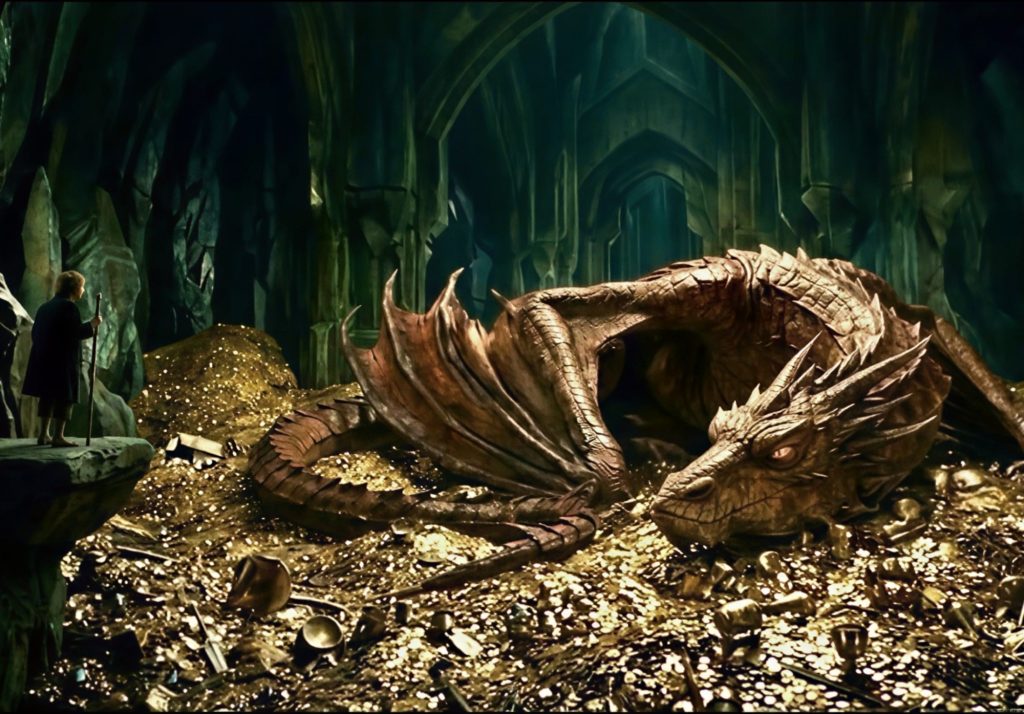
Smaug is the only character on this list who acquired his entire fortune through a single act of theft. He didn’t build a business. He didn’t mine for gold. He flew to the Lonely Mountain, killed everyone who lived there, and went to sleep on their stuff for 171 years.
It worked spectacularly well.
The Dragon of Erebor
Smaug is a fictional dragon created by J.R.R. Tolkien, appearing in The Hobbit, first published in 1937. He is described as “the greatest and chiefest of calamities of his age” — a fire-breathing dragon of extraordinary intelligence, cunning, and greed who sacked the Dwarf kingdom of Erebor (also known as the Lonely Mountain) in the Third Age of Middle-earth, killing or scattering its inhabitants and claiming the entire accumulated wealth of the dwarf civilization for himself.
The hoard Smaug lies upon is described in some of the most evocative financial language in all of literature. He sleeps on a bed of gold, silver, and gemstones. Diamonds and rubies are encrusted in his underbelly from centuries of physical contact with the treasure. He possesses the Arkenstone of Thrain — described by Tolkien as “the heart of the mountain,” a gem of surpassing brilliance that the Dwarves held above all other treasures, worth more than “a river of gold in itself.”
The Forbes Calculation
Forbes placed Smaug’s net worth at $54.1 billion in its 2012 Fictional 15 list, making him the richest fictional character that year — above Scrooge McDuck, who ranked second. The calculation was based on applying contemporary gold and silver prices to the volume of treasure described in the novel, adding estimated values for the Arkenstone and other specific gemstones mentioned in the text, and accounting for the broader wealth of Erebor as a historically significant dwarf kingdom.
He held the Forbes top spot in 2012, a year before Scrooge reclaimed it for the final Forbes list in 2013.
The Peter Jackson film adaptations — particularly The Hobbit: The Desolation of Smaug (2013), in which Smaug was voiced by Benedict Cumberbatch — brought vivid visual life to the scale of the treasure. The CGI rendering of the hoard in those films gives some sense of the physical volume involved: a mountain’s interior filled, floor to ceiling, with gold coins, weapons, armor, and jewels accumulated over 171 years of undisturbed sleep.
The Unique Wealth Story
What makes Smaug interesting as a wealth character is that his fortune is entirely static. He earns nothing. He invests nothing. He does no business. He simply possesses what he took, and the passage of centuries doesn’t diminish it because gold doesn’t rust and Smaug doesn’t spend. He is the purest possible representation of hoarded wealth — wealth with no economic function, no multiplier effect, and no purpose beyond the psychological comfort of possession.
He is, in this sense, the cautionary tale that Scrooge McDuck is often accused of being but never quite is. Scrooge at least maintains an active business empire and goes on adventures. Smaug lies still until someone bothers him about a cup.
His death, at the hands of the archer Bard of Lake-town using the Black Arrow, is precipitated not by a grand heroic challenge but by a small piece of intelligence: a missing scale on his underbelly that Bilbo Baggins identified during a tense after-dark conversation. The greatest hoard in Middle-earth was defended, ultimately, by vanity — and ended by a piece of information shared with a child.
#4 — Tony Stark (Iron Man): ~$12.4–$40 Billion

Tony Stark is the richest fictional character who built his fortune through something that most people could theoretically understand: running a technology company. He didn’t inherit a nation, find gold in the Klondike, or steal from a dwarf kingdom. He inherited a defense contractor, nearly got killed by it, had a moral crisis in a cave, and then rebuilt both the company and himself into something genuinely world-changing.
The Stark Industries Empire
Anthony Edward Stark was born to Howard and Maria Stark, founders of Stark Industries — one of the world’s leading defense and technology contractors. His parents were killed in what appeared to be a car accident (later revealed to be an assassination orchestrated by HYDRA agents) while Tony was studying at MIT, where he graduated at 17. He inherited the company at 21.
Stark Industries, under Tony’s leadership, grew from a major defense contractor into a diversified technology conglomerate. Its products have included conventional weapons systems, advanced military hardware, robotics, energy technologies (including the arc reactor, a clean energy source Tony invented), aerospace systems, and — eventually — the Iron Man suits themselves.
Forbes estimated Tony Stark’s personal net worth at $12.4 billion in its 2013 Fictional 15 list. That figure accounts for his personal stake in Stark Industries (revenue estimated at $20.3 billion annually in canonical sources), his technology patents, real estate including his Malibu cliff-side mansion, Stark Tower in New York (later renamed Avengers Tower), and the value of his Iron Man suits — estimated at approximately $7 billion for the full arsenal.
Other analyses, particularly those that factor in the arc reactor technology’s implications for global energy markets, push the figure significantly higher. If the arc reactor technology were commercially deployed at scale — providing virtually unlimited clean energy — it would be among the most valuable patents in human history. Some fan analyses estimate Stark’s total net worth, including full arc reactor commercialization, at over $40 billion.
The Self-Made Dimension
What distinguishes Stark’s wealth from most of the characters on this list is the extent to which it is genuinely self-generated rather than inherited. Yes, he started with Stark Industries — a substantial inheritance. But the company under his father’s management, while successful, was primarily a conventional weapons contractor. Tony’s personal intellectual contributions — the miniaturized arc reactor, the Iron Man exoskeleton technology, J.A.R.V.I.S. (his AI system, eventually evolving into the Vision), and dozens of ancillary innovations — created value that far exceeded what he inherited.
He is, in the Marvel universe, simultaneously the CEO of one of the world’s most powerful companies, the inventor of its most valuable technologies, and its primary marketing asset. He is, in other words, a one-man Beast Industries.
The character was created by writer Stan Lee, developed by Larry Lieber and artist Don Heck, and first appeared in Tales of Suspense #39 in March 1963. His portrayal by Robert Downey Jr. across 10 Marvel Cinematic Universe films between 2008 and 2019 made him one of the most commercially successful fictional characters in entertainment history, with the MCU films featuring him generating over $14 billion in global box office revenue.
His final act in Avengers: Endgame (2019) — deploying the Infinity Stones to erase Thanos and his army at the cost of his own life — is broadly considered one of the most powerful endings in superhero cinema. He died wealthy, brilliant, and having saved half the universe. There are worse endings.
#5 — Bruce Wayne (Batman): ~$9.2–$80+ Billion
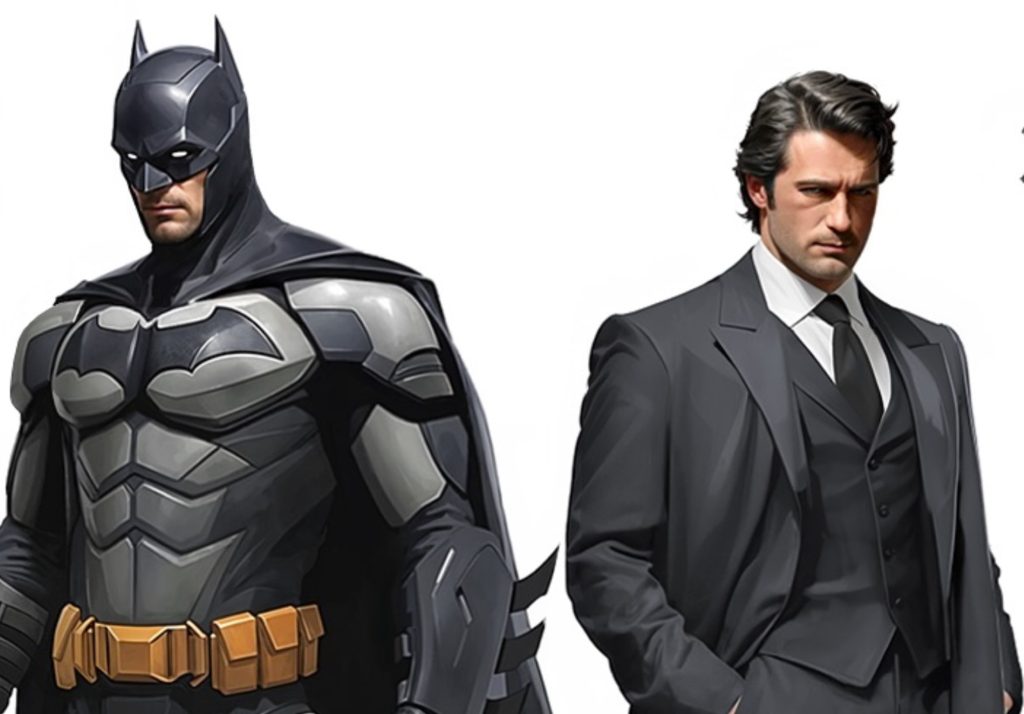
Bruce Wayne is the most recognizable fictional billionaire in American culture. His name is virtually synonymous with the concept of the masked wealthy vigilante. And unlike most of the characters on this list, his fortune has been analyzed from more angles, across more decades of comic continuity, by more fans and analysts, than perhaps any other fictional character in history.
The Wayne Enterprises Fortune
Thomas and Martha Wayne were among Gotham City’s most prominent philanthropists and industrialists before their murder at the hands of mugger Joe Chill in an alley outside the Monarch Theater — an event witnessed by their eight-year-old son Bruce, who would go on to become Batman. The Wayne family fortune, built across generations through real estate, manufacturing, and technology investments, passed in full to Bruce upon his parents’ deaths.
Wayne Enterprises, the corporate holding company Bruce inherited and eventually came to run, is canonically one of the largest conglomerates in the DC universe. Its divisions span aerospace, defense, biotech, shipping, real estate, and electronics. A 1974 Batman comic valued Wayne Enterprises at $27.4 million — a figure that, translated through decades of comic inflation and in-universe business growth, has expanded dramatically. Contemporary estimates place Wayne Enterprises’ market capitalization at anywhere from $7 billion to well over $100 billion depending on the specific DC timeline being referenced.
Forbes placed Bruce Wayne’s net worth at $9.2 billion in its 2013 Fictional 15 list, making him comfortably wealthy but significantly behind Tony Stark. Other analyses that account for Wayne Enterprises’ full business scope, including defense contracts and biotech holdings, push the estimate to $80 billion or higher. Some DC storylines have explicitly described Bruce Wayne as one of the wealthiest people alive, without quantifying a specific figure.
Batman’s $80,000-Per-Year Budget Problem
What makes Bruce Wayne’s financial story uniquely interesting is the cost side of the ledger. Every dollar of Wayne Enterprises profit that passes through Bruce’s hands is theoretically available to fund Batman operations — and those operations are extraordinarily expensive.
The Batmobile alone, in its various canonical forms, would cost tens of millions in real-world automotive and engineering terms. The Batcave’s computer systems, training equipment, vehicles, and weapons would cost billions to replicate. The batarangs are custom-manufactured titanium. The cape is a proprietary memory cloth that responds to electrical current. The chest armor is graphite-based.
Analysts who have attempted to calculate the real-world cost of becoming Batman — including a much-cited study by financial technology firm Buddy Loans — have estimated the full cost of the Batman operation (equipment, training, vehicles, and the ongoing maintenance of a billionaire’s public lifestyle as cover) at approximately $2.8 million per year at minimum, rising to hundreds of millions when major equipment overhauls are included.
Bruce Wayne funds all of this personally, off the books, through a fictional corporation in a fictional city. He is, among other things, the most elaborate spender on personal security and crime-fighting equipment in the history of fiction.
The Inheritance vs. Iron Man Debate
The ongoing fan debate between Bruce Wayne and Tony Stark — which one is richer, which one is smarter, which one has the better toys — is one of the most reliably engaging arguments in comic book culture. The financial answer is genuinely ambiguous: Forbes has ranked Stark above Wayne in most of its Fictional 15 iterations, but the margin is not large and the two characters’ wealth is, by any reasonable estimate, in the same order of magnitude.
What is clear is this: Wayne’s wealth is primarily inherited, maintained, and deployed rather than generated through personal innovation. Stark’s wealth is partly inherited and substantially generated through personal invention. In that sense, the two men represent different models of how fictional billionaires use their money — Stark as creator and Wayne as custodian — and both models produce more than enough capital to fund a superhero career.
What Makes a Fictional Character Rich? The Archetypes Behind the Numbers
Looking at the five characters on this list, several recurring archetypes emerge for how fiction creates extreme wealth.
The sovereign resource owner. T’Challa’s wealth is the purest version of this: a ruler who controls a monopoly on a commodity with no substitute and unlimited demand. This archetype appears throughout fiction whenever writers want to gesture at wealth that is effectively incomprehensible in scale. The wealth is tied to the territory rather than to personal enterprise.
The self-made entrepreneur. Scrooge McDuck is the definitive example — a character who started with nothing, earned everything, and built a global empire through a combination of intelligence, determination, and willingness to go where others wouldn’t. This archetype is the most culturally resonant because it mirrors the wealth stories that audiences find most admirable in the real world.
The hoarder. Smaug represents wealth as pure accumulation — no enterprise, no production, no economic activity of any kind. Just possession. This archetype is almost always portrayed as a cautionary tale, and Smaug’s eventual death underlines the instability of hoarded wealth with no legitimate social function.
The inheritor-innovator. Both Tony Stark and Bruce Wayne fit this archetype — characters who inherit substantial wealth and then either expand it through personal innovation (Stark) or maintain and deploy it through personal commitment (Wayne). This is the archetype closest to real-world billionaire stories, which is why these characters resonate most strongly with audiences who follow actual business news.
Comparison: How Each Fortune Was Built
| Character | Inherited? | Self-Made? | Business Operations | Passive Assets |
|---|---|---|---|---|
| T’Challa | Yes (monarchy) | No | Wakanda’s economy | Vibranium reserves |
| Scrooge McDuck | No | Entirely | Global empire | Money bin |
| Smaug | No | No (theft) | None | Stolen hoard |
| Tony Stark | Partly | Largely | Stark Industries | Real estate, patents |
| Bruce Wayne | Entirely | No | Wayne Enterprises | Real estate, investments |
Frequently Asked Questions
Who is the richest fictional character of all time?
T’Challa, the Black Panther, is the richest fictional character of all time by most calculations, with an estimated net worth of approximately $90.7 trillion. This figure derives from Wakanda’s canonically established vibranium reserves of 10,000 tons, valued at $10,000 per gram in Marvel lore. If you restrict the ranking to self-made fortunes, Scrooge McDuck — the greatest self-made fictional billionaire ever created — is the answer.
Is Scrooge McDuck a billionaire or a trillionaire?
Both, depending on which source you use. Forbes estimated his net worth at $65.4 billion in 2013, placing him comfortably in billionaire territory. Disney’s own in-universe descriptions, however, have called him a “quadrillionaire” and used made-up number names to describe his wealth. A Don Rosa-written comic implies annual earnings of approximately $3.9 trillion based on his stated tax obligations. At that income rate, compounded over decades of business activity, his total accumulated wealth would be in the trillions.
How did Smaug get his money?
Smaug acquired his fortune by attacking and destroying the Dwarf kingdom of Erebor (the Lonely Mountain) in J.R.R. Tolkien’s Middle-earth. He killed or drove out all inhabitants and claimed the kingdom’s entire accumulated treasury — centuries of dwarf craftsmanship, gold, silver, gemstones, weapons, and armor — for himself. He then slept on it for 171 years. Forbes estimated the value of his hoard at $54.1 billion, making him the richest fictional character Forbes ever ranked, in 2012.
Is Tony Stark richer than Bruce Wayne?
In most canonical estimates, yes. Forbes placed Tony Stark’s net worth at $12.4 billion and Bruce Wayne’s at $9.2 billion in its 2013 Fictional 15 list. However, other analyses — particularly those accounting for Wayne Enterprises’ full business scope — push Wayne’s net worth significantly higher, potentially above Stark’s. The margin between them is genuinely ambiguous, and different DC and Marvel storylines give different indications of the gap.
What was the Forbes Fictional 15?
The Forbes Fictional 15 was an annual list published by Forbes magazine from 2002 to 2013, ranking the 15 wealthiest fictional characters across movies, books, comics, cartoons, and television. To qualify, characters needed to be fictional in a narrative sense (mythological or folkloric figures were excluded) and genuinely wealthy. The list applied real-world financial analysis — commodity prices, business valuations, investment income — to in-universe wealth descriptions. It was discontinued in 2013 when Forbes decided to refocus on real-world business coverage.
Why is Black Panther richer than Scrooge McDuck if McDuck is the most famous fictional billionaire?
Scrooge McDuck is the most famous fictional billionaire because he was created in 1947, has appeared in thousands of comics and multiple television series, and has been a cultural reference point for extreme wealth for over 75 years. T’Challa’s wealth, by contrast, only became a mainstream cultural reference point with the 2018 Black Panther film. But the math is unambiguous: vibranium, priced at $10,000 per gram and present in Wakanda in quantities of 10,000 tons, produces a resource value that no gold-filled money bin can match. T’Challa is simply playing a different game — sovereign resource ownership versus individual enterprise.
Could any of these characters exist in the real world?
Scrooge McDuck and Tony Stark are the most plausibly translatable. Scrooge’s business model — aggressive mining, treasure hunting, and global commerce — has real-world analogues in mining magnates, sovereign wealth funds, and commodity traders. Tony Stark’s model — inheriting a defense contractor and expanding it through personal innovation — maps directly onto historical examples like Howard Hughes, who Stark was partly modeled after. T’Challa’s wealth, tied to a fictional metal, has no real-world equivalent. Smaug is a dragon. Bruce Wayne comes closest to real-world ultra-high-net-worth individuals: a philanthropist billionaire who inherited a conglomerate and runs it competently while pursuing an expensive personal mission.
Conclusion
The top 5 richest fictional characters of all time tell five completely different stories about how extreme wealth is imagined, built, and used.
T’Challa’s $90.7 trillion is the wealth of a nation — a resource monopoly so vast it defies real-world comparison. Scrooge McDuck’s fortune is the definitive self-made story in all of fiction — built from a single dime, through decades of work, across every corner of an adventure-filled world. Smaug’s $54.1 billion is theft as investment strategy — take everything, spend nothing, and sleep on it for 171 years. Tony Stark’s $12.4 billion is the inheritor who became the innovator. Bruce Wayne’s $9.2 billion is the inheritor who became the custodian and the vigilante.
None of them earned it the same way. None of them spent it the same way. But they all share one thing: they captured the human imagination’s deepest curiosity about what it would feel like to have more money than you could ever spend — and what you would do with it if you did. If you want to know more about Hollywood actors, you can check out our article on Hollywood Highest Paid Actor or you can read about the Richest Hollywood Actors, you can also check out the Richest British Actors in Hollywood or the Richest Voice Actors. And if you like it you can check more of our Celebrity Net Worth list.
Check out Autor’s Social Media: (fakhirking97)