Jensen Huang’s net worth is estimated at approximately $165 billion to $181 billion as of 2026, making him one of the ten wealthiest individuals on Earth and the richest person ever produced by the semiconductor industry. He built that fortune by holding a roughly 3.5% stake in Nvidia — a company he co-founded in a Denny’s restaurant booth in San Jose in 1993 and has led for every one of the thirty-three years since.
There is no secondary business. No venture fund moonlighting. No celebrity brand or real estate empire padding the numbers. Approximately 97% of Jensen Huang’s net worth is a single asset: Nvidia stock. That concentration makes his financial story simultaneously simpler and more extraordinary than almost any other billionaire’s — simpler because the arithmetic is straightforward, more extraordinary because it means that one man held his stake in one company through near-bankruptcy, through the dot-com bust, through a decade of being dismissed as a gaming chip maker, and through the most violent stock appreciation in the history of American business.
When Nvidia reported $130.5 billion in revenue for fiscal year 2025 — not market capitalisation, not a projected valuation, but actual revenue paid by actual customers — it became clear that what Huang had built was not a bubble. It was the infrastructure layer of the AI revolution. And the man who held 3.5% of it became, with jarring speed, one of the wealthiest human beings who have ever lived.
Quick Facts: Jensen Huang at a Glance
| Category | Details |
| Full Name | Jen-Hsun Huang (黃仁勳) |
| Date of Brith | February 17, 1963 |
| Age (2026) | 63 |
| Birthplace | Taipei, Taiwan |
| Raised | Thailand, then United States (from age 9) |
| Net Worth (2026) | ~$165–$181 billion |
| Primary Wealth Source | ~3.5% equity stake in Nvidia Corporation |
| Nvidia Shares Held | ~78.7 million shares (plus trust/family entity holdings) |
| Nvidia FY2025 Revenue | $130.5 billion |
| Nvidia Market Cap | ~$3.4–5+ trillion (2026) |
| Nvidia Data Center Revenue | $115+ billion (FY2025) |
| Annual Compensation | $49.8 million (salary + stock awards in FY2025) |
| Education | B.S. Electrical Engineering, Oregon State (1984); M.S. Electrical Engineering, Stanford (1992) |
| Nvidia Co-founders | Chris Malachowsky, Curtis Priem |
| Nvidia Founded | January 25, 1993 (Denny’s, San Jose, CA) |
| Spouse | Lori Huang (née Mills, married 1985) |
| Children | Madison Huang, Spencer Huang |
| Notable Relative | Lisa Su (AMD CEO; cousin) |
| Philanthropy | $80M+ donated; $50M to Oregon State, $30M to Stanford |
| Signature Look | Black leather jacket |
From Taiwan to Denny’s: The Origin Story That Built $165 Billion
Jensen Huang was born Jen-Hsun Huang on February 17, 1963, in Taipei, Taiwan. His early life moved across borders. His family relocated to Thailand before emigrating to the United States when he was nine years old — a period of displacement and adaptation that Huang has reflected on as formative. He has spoken about arriving in America with limited English and attending Oneida Baptist Institute in rural Kentucky, a boarding school that accepted him despite his youth. By his own account, he was younger than almost everyone around him and determined to prove himself regardless.
He graduated from Aloha High School in Oregon and worked during his teenage years as a dishwasher, busboy, and waiter at a Denny’s restaurant. This detail has become legendary in the Nvidia story, partly because the company he would later co-found was conceived in a different Denny’s booth. In a life full of improbable circularity, the restaurant chain that employed him as a teenager became the setting for the conversation that would make him one of the world’s richest people.
He earned a bachelor’s degree in electrical engineering from Oregon State University in 1984. At Oregon State, he met Lori Mills, his engineering lab partner, in circumstances he has described with characteristic warmth: “I was the youngest kid in school. There were 250 students and 3 girls. So my probability of success was high.” They married in 1985, and the partnership that began over homework has lasted through every stage of what Nvidia would become.
After Oregon State, Huang worked at LSI Logic and then Advanced Micro Devices (AMD) — the same company that his cousin Lisa Su would later lead to its own remarkable resurgence as a semiconductor giant. He completed his Master’s degree in Electrical Engineering from Stanford University in 1992 while working, demonstrating the combination of technical rigor and relentless work ethic that would define his leadership of Nvidia.
On January 25, 1993, Huang sat down with two colleagues — Chris Malachowsky and Curtis Priem, both from Sun Microsystems — at a Denny’s in San Jose, California, and they sketched the outlines of a new company. The founding vision was to build a graphics processing unit that would make PC gaming visually compelling. What they could not have imagined — what no one imagined — was that the architecture they developed for rendering video game graphics would turn out to be exactly the right architecture for training artificial intelligence. That accident of technical foresight is the foundation of Jensen Huang’s $165 billion fortune.

Jensen Huang’s Net Worth: The Anatomy of a $165 Billion Fortune
Understanding Jensen Huang’s wealth requires understanding one number above all others: 3.5%. That is his approximate ownership stake in Nvidia, the company he has led without interruption since its founding in 1993. When Nvidia’s market capitalisation moves by $1 trillion, Huang’s personal net worth moves by approximately $35 billion. When it falls, it falls at the same rate.
The Equity That Created Everything
Huang holds approximately 78.7 million shares of Nvidia common stock plus millions of vested restricted stock units. At $280 per share (a representative 2026 price), that stake is worth roughly $22 billion in directly held shares alone. Additional wealth comes through trusts and family entities that hold separate Nvidia positions. Total package, depending on the stock price on any given Tuesday, ranges from $165 billion at conservative estimates to $181 billion at peaks.
This concentration is unusual among billionaires of comparable wealth. Most people who accumulate $100 billion or more do so through a combination of founding equity, diversified investment portfolios, and asset accumulation over decades. Huang has done something rarer: he has simply held his founding stake for thirty-three years, through every market cycle and every industry transformation, and allowed Nvidia’s growth to compound his wealth for him.
The cost of that approach is extreme volatility. Nvidia’s stock has experienced drawdowns of 60, 70, and even 80% during previous market cycles. Huang’s net worth would have fallen by comparable amounts during each of those periods. The willingness — or stubbornness, depending on perspective — to hold through those collapses is what produced the $165 billion outcome. Most founders dilute their stakes through secondary sales, equity grants, and diversification transactions. Huang has sold relatively little.
Nvidia’s Revenue: Why the Valuation Is Grounded in Reality
One of the most important things to understand about Jensen Huang’s net worth is that it is not primarily a function of speculative market sentiment. It reflects a company generating extraordinary real revenue.
NVIDIA reported $130.5 billion in revenue for fiscal year 2025 (ending January 2026). Data center revenue exceeded $115 billion annually — dwarfing the gaming business that built the company. Over 5 million CUDA developers worldwide use NVIDIA’s computing platform. NVIDIA commands over 90% of all AI model training runs on its hardware.
To put $130.5 billion in annual revenue in context: that is more revenue than Netflix, Airbnb, Spotify, Snap, Pinterest, and Twitter/X combined. It is more than McDonald’s and Starbucks combined. It was generated primarily by a single product category — data center AI chips — that barely existed as a meaningful revenue line five years ago.
Not market capitalization. Revenue. Actual money paid by actual customers for actual chips. When a company generates that kind of cash and trades at the valuation Nvidia commands, the founder who held his stake becomes something the financial world had not previously encountered at this scale.
Nvidia’s Annual Compensation: The Salary Behind the Billions
Jensen Huang’s compensation from Nvidia in fiscal 2025 totaled $49.8 million. That includes base salary, stock awards, and other compensation. It sounds like a lot until you realize it represents roughly 0.00003% of his total net worth. His real wealth creation is not salary. It is ownership.
That mathematical relationship is perhaps the clearest illustration of why equity is the only wealth-building mechanism that matters at Huang’s level. Every dollar of salary he earns while Nvidia’s stock moves 1% generates perhaps $1.65 billion in paper wealth appreciation from his stake. The salary is effectively noise.

The Nvidia Story: How a Gaming Chip Company Became the Infrastructure of AI
Understanding Jensen Huang’s net worth is inseparable from understanding how Nvidia made one of the most significant pivots in corporate history — from a company that made graphics cards for gamers to the indispensable hardware provider for every AI laboratory on Earth.
1993–2006: The Gaming Years
Nvidia’s first decade was defined by GPU innovation for gaming. The company released the RIVA 128 in 1997, the first true consumer GPU, and followed it with the GeForce 256 in 1999 — marketed as the “world’s first GPU” and a genuine breakthrough in 3D rendering for PC games. Nvidia went public on the Nasdaq in January 1999 at a market capitalisation in the hundreds of millions.
During this period, Nvidia nearly went bankrupt. The company came within one month of missing payroll in the early years, surviving only through an emergency credit line. Huang has spoken about this period openly, noting that the experience of near-failure shaped how he thinks about business strategy and long-term planning.
2006–2016: CUDA and the Bet Nobody Placed
In 2006, Nvidia introduced CUDA (Compute Unified Device Architecture) — a programming model and software platform that allowed developers to use Nvidia GPUs for general-purpose computing tasks. At the time, this was a niche tool used primarily by researchers and scientists who needed massive parallel processing power for simulations, fluid dynamics calculations, and other computationally intensive tasks.
Almost nobody in the investment community treated CUDA as significant. Nvidia was a gaming chip company. The idea that a programming model for scientific computing would eventually make Nvidia the most valuable semiconductor company in history was not a mainstream investment thesis.
In 2012, researchers at the University of Toronto used Nvidia CUDA GPUs to train AlexNet, a deep neural network that won the ImageNet competition by a margin that shocked the AI research community. AlexNet demonstrated conclusively that deep learning on GPU hardware could solve computer vision problems that had resisted decades of conventional approaches. The AI research community immediately began acquiring Nvidia GPUs.
2016–2022: The AI Build-Up
Through the late 2010s, Nvidia’s data center revenue began growing alongside the expansion of deep learning research. The company released the Tesla V100 and A100 data center GPUs, purpose-built for AI training workloads, and progressively built the software ecosystem that made its hardware the preferred choice of AI researchers globally.
By the time OpenAI released ChatGPT in November 2022, Nvidia was already the dominant supplier of AI training hardware. Every major AI laboratory depended on Nvidia hardware to train their foundation models. The H100 GPU became so coveted that lead times stretched to 52 weeks and secondary market prices reached two to three times list price.
2022–2026: The Revenue Explosion
What happened to Nvidia’s revenue between 2022 and 2026 has few precedents in corporate history. The company went from approximately $27 billion in annual revenue in fiscal 2022 to $130.5 billion in fiscal 2025 — a nearly five-fold increase in three years.
Revenue for the third quarter of fiscal year 2026 was a record $57.0 billion, up 62% from a year ago. A single quarter of $57 billion in revenue. In a company that generated $27 billion for an entire fiscal year just three years earlier. Jensen Huang built that.
The Blackwell and Vera Rubin Architecture: Why Nvidia’s Lead Compounds
One of the most important reasons Jensen Huang’s net worth is likely to remain at its current level is Nvidia’s architectural lead over its competitors, which has proven remarkably durable.
In early 2026, Nvidia officially transitioned from the Blackwell era to the Rubin platform. Named after astronomer Vera Rubin, this architecture isn’t just a chip — it’s a “giant brain” for data centers. The Rubin GPU reduces AI inference costs by up to 10x compared to previous generations. Following the CES 2026 keynote, Nvidia became the first company to maintain a $5 trillion market valuation, surpassing Apple and Microsoft.
The competitive moat Nvidia has built is not primarily about chip design. It is about CUDA. With over 5 million developers who have built their AI systems on the CUDA ecosystem, switching to a competitor’s hardware means rewriting software, retraining teams, and accepting performance regressions. That switching cost is the structural defence that makes Nvidia’s market position so durable.
Personal Life: The Leather Jacket, the Lab Partner, and the Family That Works at Nvidia
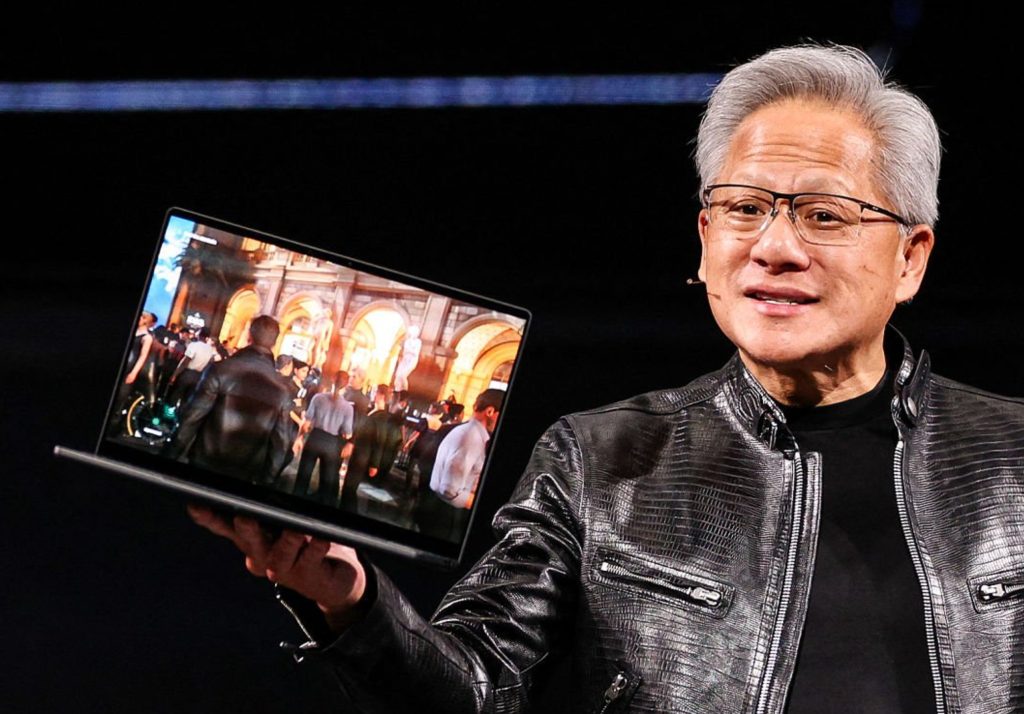
Jensen Huang’s personal life is notable for how deliberately unglamorous it has remained relative to his wealth. He is not a fixture of the international billionaire social circuit. He does not maintain a super-yacht or a private island. His most recognisable personal brand element is his signature black leather jacket — which he has worn to virtually every public appearance for years, and which he has revealed was selected by his wife Lori and daughter Madison.
Lori Huang, his wife since 1985, was his engineering lab partner at Oregon State. She stepped back from professional work to focus on family during Nvidia’s formative years, and has been the consistent personal support structure behind decades of professional intensity.
Their two children have both built careers inside the company their father leads. Madison Huang is Director of Product Strategy for Nvidia Omniverse, and Spencer Huang is a Product Manager working on Nvidia’s AI developer ecosystem.
Jensen Huang vs. Other Tech Billionaires: Wealth Comparison
| Name | Est. Net Worth (2026) | Primary Wealth Source | Company |
| Elon Musk | ~$300+ billion | Tesla, SpaceX, xAI equity | Multiple |
| Jeff Bezos | ~$230+ billion | Amazon equity | Amazon |
| Mark Zuckerberg | ~$210+ billion | Meta Platforms equity | Meta |
| Larry Ellison | ~$175+ billion | Oracle equity | Oracle |
| Jensen Huang | ~$165–181 billion | Nvidia equity (~3.5% stake) | Nvidia |
| Bill Gates | ~$170+ billion | Investment portfolio, Microsoft | Microsoft |
| Larry Page / Sergey Brin | ~$140–150 billion each | Alphabet equity | Google/Alphabet |
| Sam Altman | ~$3.3–4 billion | Venture investments | OpenAI (no equity) |
What distinguishes Huang in this group is the speed of his ascent. Musk, Bezos, Zuckerberg, and Ellison all built their fortunes over two to three decades of continuous company growth. Huang built his over thirty years too — but the majority of his wealth was created in a compressed window of roughly three years between 2022 and 2025.
The 97% Concentration Risk: The Paradox of His Fortune
The most remarkable and most dangerous aspect of Jensen Huang’s net worth is the concentration risk. Roughly 97% of everything Jensen Huang owns exist as shares in the company he cofounded in a Denny’s booth thirty-three years ago.
By the standards of conventional wealth management, this is imprudent to the point of recklessness. A 97% concentration in a single stock means that a severe market downturn, a regulatory catastrophe, or a technological disruption could erase the vast majority of Huang’s fortune.
Huang has shown no inclination to meaningfully diversify, which is consistent with his philosophy as both a CEO and a person. He has described himself as someone who plays long games and believes deeply in Nvidia’s long-term mission. The concentration is not an oversight — it is a statement of conviction.
Frequently Asked Questions
What is Jensen Huang’s net worth in 2026?
Jensen Huang’s net worth is estimated at approximately $165 billion to $181 billion as of 2026, according to Forbes and Bloomberg. The range varies based on Nvidia’s stock price on any given day, as approximately 97% of his fortune is held in Nvidia shares.
How did Jensen Huang make his money?
Jensen Huang built his fortune by co-founding Nvidia in 1993 and retaining approximately a 3.5% equity stake in the company for over thirty years. As Nvidia grew from a gaming GPU company into the dominant supplier of AI chips, generating $130.5 billion in revenue for fiscal year 2025, his stake appreciated from essentially nothing to $165 billion or more.
Does Jensen Huang own all of Nvidia?
No. Huang owns approximately 3.5% of Nvidia, making him its largest individual shareholder but not a majority owner. Other major shareholders include institutional investors such as Vanguard and BlackRock.
What is Jensen Huang’s salary at Nvidia?
Huang’s total compensation from Nvidia for fiscal year 2025 was approximately $49.8 million, including base salary, stock awards, and other benefits. This represents a tiny fraction of his overall net worth, which is driven by equity appreciation rather than salary.
Who are Jensen Huang’s co-founders of Nvidia?
Nvidia was co-founded by Jensen Huang, Chris Malachowsky, and Curtis Priem at a Denny’s restaurant in San Jose, California, on January 25, 1993. Malachowsky and Priem both came from Sun Microsystems.
Is Jensen Huang related to Lisa Su?
Yes. Jensen Huang and Lisa Su — the CEO of AMD, Nvidia’s primary competitor in the GPU market — are cousins. Both are Taiwanese-American and have led their respective companies to extraordinary growth during the AI era.
What is CUDA and why does it matter to Jensen Huang’s wealth?
CUDA (Compute Unified Device Architecture) is Nvidia’s programming platform, introduced in 2006, that allows developers to use Nvidia GPUs for general-purpose computing. With over 5 million CUDA developers worldwide, the platform has created a software ecosystem that makes switching from Nvidia hardware to competitors extremely difficult.
What philanthropic work has Jensen Huang done?
Jensen Huang and his wife Lori have donated over $80 million through their foundation. Key gifts include $50 million to Oregon State University (2022), and $30 million to Stanford University.
Conclusion: The Denny’s Dishwasher Who Built the Infrastructure of the AI Age
Jensen Huang’s net worth of $165 billion is the financial expression of a single sustained conviction: that parallel computing would eventually matter more than the rest of the world thought. He formed that conviction in the early 1990s, built a company around it, bet his founding equity on it, and held that equity through thirty-three years of market cycles, near-bankruptcy, competitive attacks, and an AI revolution that his own technology infrastructure made possible.
The 3.5% stake in Nvidia that generated his $165 billion fortune was not created by a lucky pivot or a fortuitous acquisition. It was created by identifying, in 1993, that graphics processing required a fundamentally different computing architecture — and then realizing, a decade later, that the same architecture was what AI needed. The gap between those two insights was the patience that most people, and most companies, simply do not have.
He started as a Denny’s dishwasher in Oregon. He went on to make Nvidia the first company to sustain a $5 trillion market valuation. He now holds the IEEE Medal of Honor and the Queen Elizabeth Prize for Engineering. His children work at the company he built. His wife, his lab partner in college, has been beside him for every step. You can check out more of the other Richest People Who Lost It All as well as Highest-Paid CEOs